
Discovering sexual betrayal doesn’t just take one thing from you. It takes two.
You lose the partner you thought you had; the person you trusted, leaned on, and built a life around. And you lose yourself; the version of you who slept through the night, who didn’t check phones, who trusted their own read on reality. Both of these are gone in a single moment.
That isn’t just a heartbreak. It’s a relational trauma. And what you are feeling right now is exactly what happens to a human nervous system when the person you depended on most becomes the source of the deepest harm.
It has a name: Complex Partner Betrayal Trauma. And naming and understanding what is happening inside you is the first step back toward stable ground.
Is any of this happening for you right now?
- Your emotions are huge and they change by the hour
- You can’t concentrate, can’t remember, can’t make a decision
- Your body hurts in ways it didn’t used to
- You’re hyper-vigilant — checking, watching, unable to switch off
- You don’t recognize yourself anymore
- You can’t tell who’s safe; you were wrong about the person closest to you
- You wonder if life will ever feel meaningful or hopeful again
If you nodded through that list, then please understand that none of this means something is wrong with you. It means something has happened to you. Something real. Something serious. Something the field of trauma has actually studied and named.
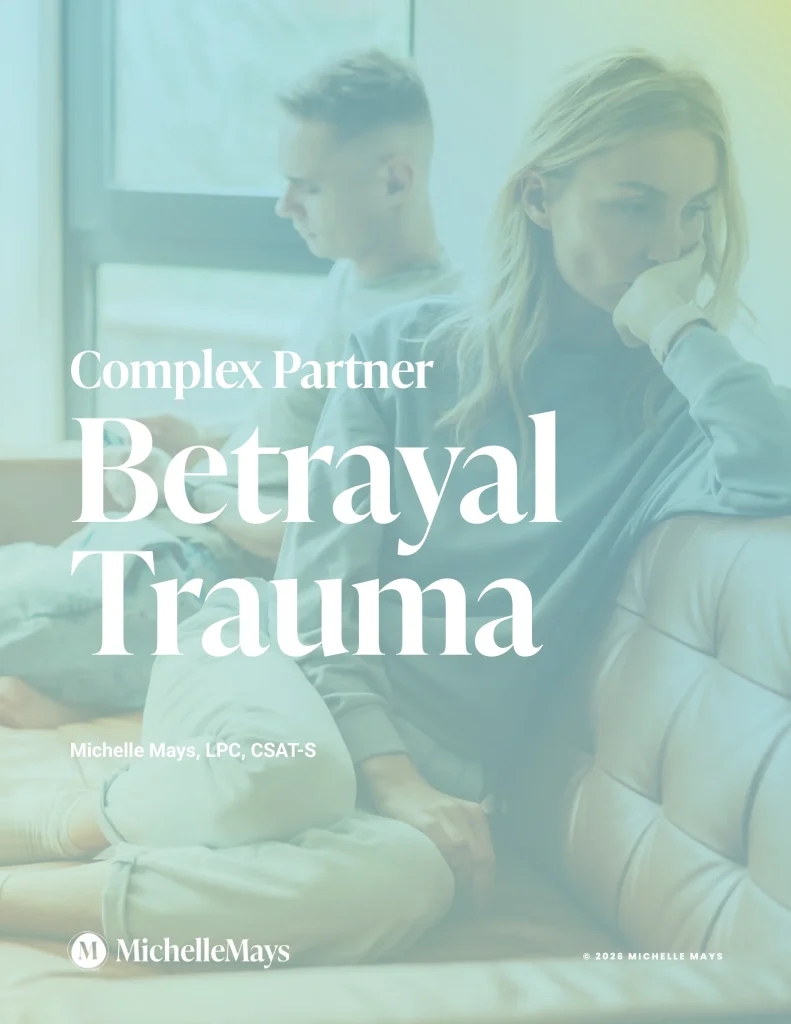
What’s Inside the Free Complex Partner Betrayal Trauma Guide:
This 17-page guide walks you through the framework that has helped thousands of betrayed partners begin to make sense of their experience and move toward healing.
Inside, you’ll learn:
- Why intimate betrayal is a relational trauma, not a relationship problem and why so many traditional approaches miss what is actually happening to you.
- The two categories of complex trauma symptoms every betrayed partner needs to recognize: emotional dysregulation and relational disconnection.
- The dynamic, multi-dimensional nature of betrayal trauma, why this experience feels like it has no edges, and why it doesn’t unfold like other traumas.
- The “heartshot” of relational trauma – the violation of dependency, vulnerability, and trust that lies underneath all the symptoms.
- Why disconnection is the wound and connection is the cure and what that means for the healing road ahead.
This is the lens that changes everything. Once you can name what is happening healing becomes possible.
About the Author:

Michelle Mays, LPC, CSAT-S, is one of the leading clinical voices in the treatment of partner betrayal trauma. A Licensed Professional Counselor and Supervisor, a Certified Sex Addiction Therapist and Supervisor, and the developer of The Braving Model™, she has spent more than twenty-five years treating betrayed partners and the couples affected by intimate betrayal.
She is the author of The Betrayal Bind: How to Heal When the Person You Love the Most Has Hurt You the Worst (now in its Second Edition), and the founder of the Relational Recovery Institute, where she trains and certifies therapists and coaches in attachment-based betrayal trauma care.


